Words that make product copy sound AI-written (and what to write instead)
The AI words to avoid in product copy, from a study of 15 million research abstracts: why AI uses them, what to write instead, and what Google says.
- Written by
- Profitonium team
- Published
- Reading time
- 5 min
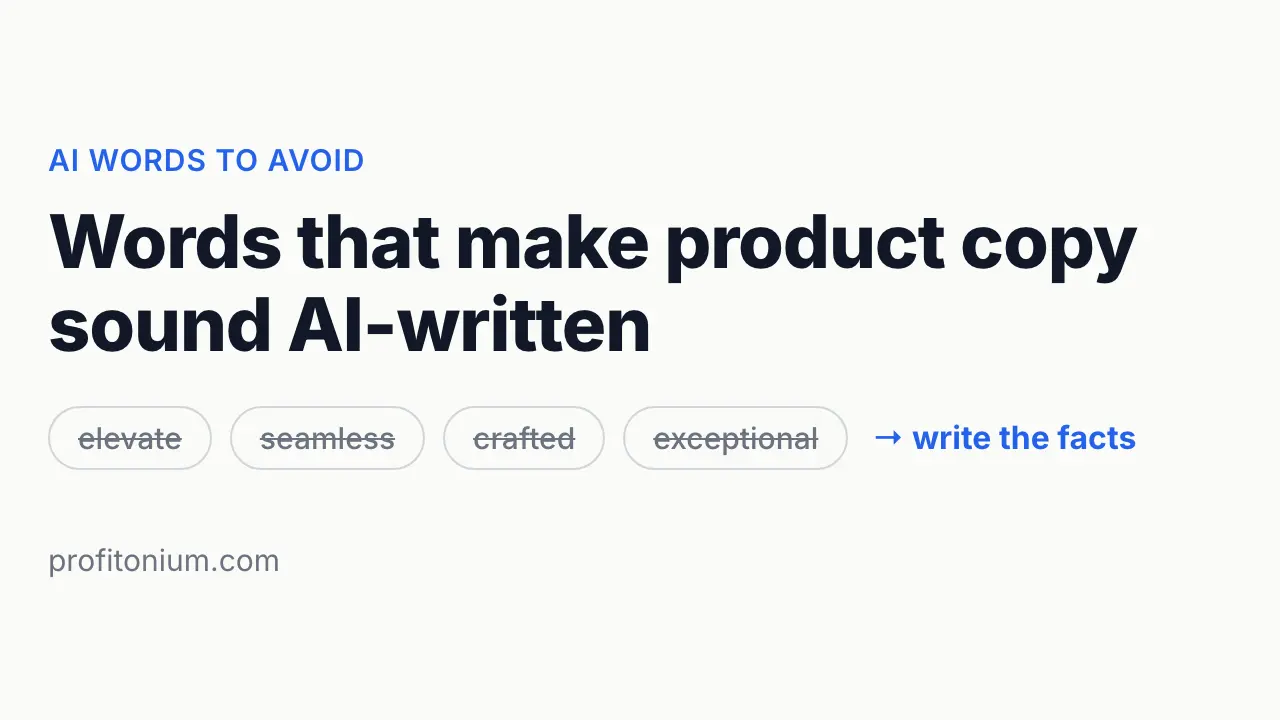
Most of the AI words to avoid in product descriptions are filler like elevate, seamless, crafted, exceptional and remarkable. Researchers saw words like these jump in published research after ChatGPT came out.
Cutting them takes a minute. The harder part is adding the product facts they were covering for, and that's where the time goes.
Common AI words to avoid, and what to write instead
These are the words from the research list we'd look for first in product copy. The examples come from the demo water bottle further down.
| If the draft says | Write this instead |
|---|---|
| Elevate | What changes for the buyer, with a number ("keeps tea hot for 12 hours") |
| Crafted | The material, and how it's made if you know ("double-wall steel") |
| Seamless, seamlessly | What it fits or works with ("fits most car cup holders") |
| Versatility | Two or three specific uses ("cold water or hot tea") |
| Exceptional, remarkable, impressive | The spec that's better, with the number ("cold for 24 hours") |
| Innovative, groundbreaking | The feature and what it does ("5.5 cm mouth takes ice cubes") |
| Transformative, unparalleled | A comparison you can back up, or nothing |
| Enhances, unlocking | A result the shopper can see or measure ("outside stays dry in your bag") |
| Harness, empowers | What the buyer can actually do with it |
| Streamline, streamlined | The step it removes or the time it saves |
| Renowned | Who rates it and where, if you can link to it |
| Invaluable | One specific situation where it helps |
| Compelling, distinctive | The detail that sets it apart, like color, cut or finish |
| Dependable | The warranty, rating or test result |
| Swift, swiftly | The actual time or speed |
Google's Merchant Center guidelines push the same way. Its description best practices ask for specific, accurate details like size, material and technical specs, and its requirements rule out gimmicky promotional text.
Where does this list come from?
The best data we found comes from a study of 15.1 million PubMed research abstracts by Dmitry Kobak and colleagues, published in Science Advances in July 2025. They compared how often words appeared before and after ChatGPT. By 2024 the extra words were nearly all style words, not topic words, and they estimate at least 13.5% of that year's abstracts went through an AI model (full paper).
Their list has 291 less common words that showed up more often than expected in 2024, and every word in the table above is on it.
Google's own help pages have a good example. In Merchant Center help, the sample AI-written description for a Chromecast starts "Transform your TV with the effortless power of Google Chromecast" and later uses unlocking. The non-AI sample on the same page just says what the device does and that it has an HDMI connector.
There are limits to all this. The study looked at research abstracts, not product pages, and we couldn't find a published study that does the same for product copy. The authors also say their method can't tell whether any single text was AI-processed. So one "seamless" proves nothing. We'd worry about a page with lots of these words and very few facts, not about a single word.
Why does AI write product copy like this?
Google's guidance on generative AI content points out that AI models predict a likely sequence of words. They don't look facts up. So if you ask for a description of "an insulated water bottle" and give no specs, we think general praise is the most likely result. Praise is all the model has to work with.
Demo: one product, two descriptions
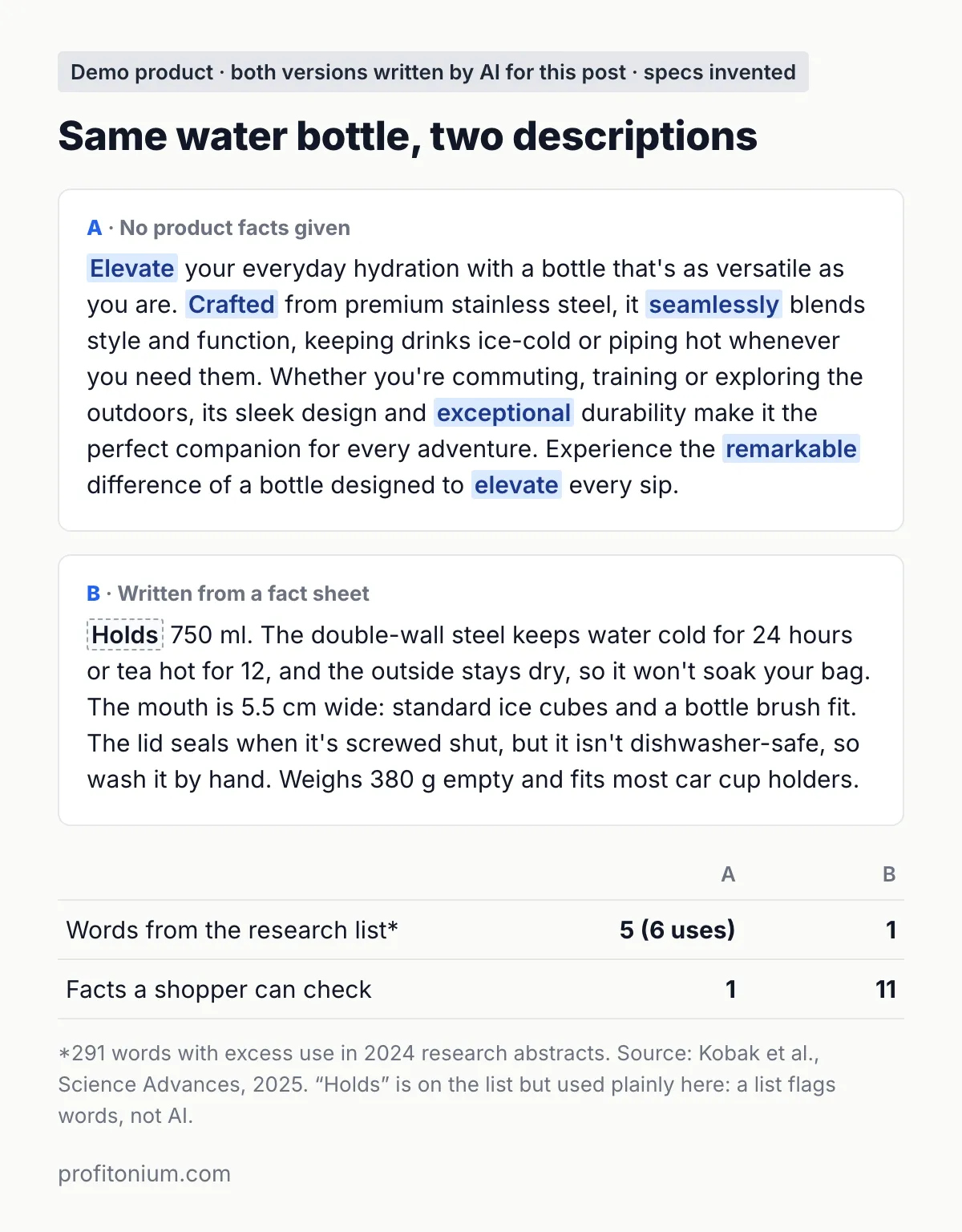
We asked an AI model to describe a made-up water bottle twice. The first time it got nothing but the product type. The second time it got a short fact sheet, with specs we invented for this demo.
Version A uses five words from the study's list, and "elevate" shows up twice. It has one fact a shopper could check, stainless steel, and that wasn't in what we gave it. The model guessed. On a real product page, that guess could be wrong.
Version B uses one word from the list: "holds," as in "Holds 750 ml." That's an ordinary word doing its job, which is why we'd use a word list as a reason to reread a sentence, not as proof of anything. B also gives a shopper 11 things to check, like capacity, how long drinks stay cold or hot, weight and whether it fits a car cup holder.
Does Google penalize AI-written product descriptions?
Not just for being written by AI. Google's 2023 post on AI content says using AI appropriately isn't against its guidelines. Using it mainly to manipulate rankings is.
Its current guidance, last updated October 1, 2026, makes two more points. Churning out lots of pages that add nothing for users may count as scaled content abuse under its spam policies. And a person should fact-check AI-written content before it goes live, including page titles, meta descriptions and image alt text.
If you send products to Google Merchant Center, there's a firmer rule. AI-generated descriptions have to go in the structured_description attribute and AI-generated titles in structured_title, with the digital source type set to trained_algorithmic_media. Google says products that don't meet its description requirements can be disapproved.
A prompt rule you can copy
Write a product description using only the facts listed below.
Do not use these words: elevate, crafted, seamless, seamlessly, exceptional,
remarkable, innovative, groundbreaking, transformative, unparalleled, unlocking.
If a fact is not listed, leave it out. Do not guess materials, sizes or claims.

Product facts:
Paste your spec sheet under the last line. The word ban helps, but the facts do most of the work. If a product's data is thin, fill in the missing fields before you generate anything.
If you run a large catalog on Shopify, our Shopify SEO audit checks titles, descriptions and missing fields in a sample of your products, plus crawl and indexing issues, for a fixed price.
Sources
- Kobak et al., excess vocabulary in 15.1 million PubMed abstracts, Science Advances, July 2025 (preprint)
- Description attribute and best practices, Google Merchant Center Help, checked November 2026
- AI-generated titles and descriptions, Google Merchant Center Help, checked November 2026
- Using generative AI content on your website, Google Search Central, updated October 2026
- Google Search's guidance about AI-generated content, Google Search Central Blog, February 2023
Want this done for your catalog?
Book a call and tell us about your store.